
The way we consume video content is changing rapidly. By the time you finish reading this sentence, global viewers will have streamed more than 28 terabytes of video—roughly the data footprint of every Oscar-winning movie combined.
For OTT and IPTV platforms, milliseconds translate into millions. A delayed stream can cost a sports broadcaster thousands of angry tweets and a chunk of churned subscribers. That’s where Content Delivery Networks (CDNs) come into play, revolutionizing the streaming experience by reducing buffering and improving video quality.
In this comprehensive guide, we’ll explore the leading CDN IPTV services that provide legal streaming options for consumers looking to cut the cord without sacrificing quality or content variety.
Key Takeaways
- Discover the top CDN IPTV services for legal streaming options.
- Understand how Content Delivery Networks transform streaming experiences.
- Learn why CDN technology is crucial for modern streaming platforms.
- Examine the differences between various CDN solutions and their impact on your viewing experience.
- Get the knowledge you need to make informed decisions about your streaming services.
Understanding CDN IPTV Services
Understanding CDN IPTV is crucial for appreciating the quality of streaming services. A Content Delivery Network (CDN) plays a vital role in delivering high-quality IPTV streams.
Network Infrastructure
A CDN is a globally distributed network of proxy servers deployed in multiple data centers. The goal of a CDN is to serve content to end-users with high availability and high performance.
Key aspects of CDN IPTV include:
- A Content Delivery Network (CDN) forms the backbone of modern IPTV services, consisting of strategically placed servers across multiple data centers worldwide.
- CDNs transform how video content reaches viewers by storing cached copies on edge servers closer to end-users.
- For IPTV services, CDNs solve the challenge of delivering high-quality video streams to thousands or millions of viewers.
- The primary function of a CDN is to distribute the delivery load across multiple servers, preventing any single point of failure.
- Understanding CDN technology helps appreciate why some streaming services perform better during high-demand events.
The Growing Demand for Streaming Content
As consumers increasingly abandon traditional cable subscriptions, the demand for flexible streaming options is skyrocketing. This shift is driven by the growing popularity of Over-the-Top (OTT) services, which have revolutionized the way people consume video content.
Market Trends and Consumer Behavior
The global OTT revenue has exceeded $275 billion, fueled by cord-cutters, niche content verticals, and Ad-Supported Video on Demand (AVOD) models. According to Cisco’s Annual Internet Report, video will account for 82% of all IP traffic by 2026, with live streaming being the fastest-growing sub-segment.
- The streaming landscape has transformed dramatically, with global OTT revenue surpassing $275 billion.
- Video content dominates internet traffic, projected to account for 82% of all IP traffic by 2026.
- Live streaming is the fastest-growing segment, driven by sports, concerts, and special events.
For a more detailed analysis of the competitive landscape, you can explore comparisons with other services, such as Apollo Group TV competitors.
The growing demand for streaming content presents both opportunities and challenges for providers. To meet these demands, it’s essential to understand the key trends shaping the industry.
| Trend | Description | Impact |
|---|---|---|
| Increasing Demand for Live Streaming | Live events and sports driving massive concurrent viewership | Tests the limits of traditional delivery systems |
| Rise of AVOD Models | Ad-supported video on demand models gaining popularity | Provides an alternative revenue stream for providers |
| Growing Audience Fragmentation | Audience spread across multiple platforms | Creates a competitive environment for streaming services |
By understanding these trends and their implications, streaming services can better position themselves to meet the growing demand for high-quality content.
How CDN IPTV Works
By leveraging a global network of servers, CDN IPTV minimizes buffering and enhances streaming quality.
Technical Infrastructure Behind Streaming
CDN IPTV systems operate through a sophisticated infrastructure that caches content closer to viewers, reducing the distance data must travel.
- A CDN automatically routes your request to the nearest server containing the content.
- Modern CDN infrastructure implements adaptive bitrate streaming technologies.

Benefits of Using CDN for IPTV Streaming
Utilizing a Content Delivery Network (CDN) for IPTV streaming offers numerous advantages, including improved performance and reduced buffering. By distributing content across multiple global locations, CDNs enhance the streaming experience.
Performance and Cost Advantages
CDNs provide several key benefits, including faster content delivery and lower bandwidth costs. The advantages of using a CDN for IPTV streaming include:
- Faster content delivery through edge servers closer to viewers, reducing latency and buffering.
- Improved reliability and scalability by distributing content across multiple locations.
- Cost savings on bandwidth and hosting by reducing long-distance data transmission.
By leveraging CDN technology, IPTV providers can ensure a high-quality streaming experience while optimizing their costs.

Types of CDN Solutions for IPTV
CDN solutions play a vital role in the IPTV ecosystem, offering various architectures to suit different needs. The right CDN can significantly enhance the streaming experience by providing high-quality, secure, and reliable content delivery.
Comparing Different CDN Architectures
The CDN landscape offers three primary architectural solutions for IPTV delivery: Public CDNs, Private CDNs, and Hybrid CDNs. Each has distinct advantages depending on your specific streaming requirements and business model.
- Public CDNs provide global reach through thousands of servers distributed worldwide, offering immediate scalability and cost-efficiency for providers looking to reach diverse geographic audiences without significant upfront investment.
- Private CDNs give organizations complete control over their delivery infrastructure, offering enhanced security, customization options, and potentially lower long-term costs for providers with predictable, high-volume streaming needs.
- Hybrid CDN solutions combine elements of both public and private models, allowing providers to maintain private infrastructure for core markets while leveraging public CDNs for global expansion or handling unexpected traffic spikes.
Your choice between these CDN architectures should be guided by factors including your target audience location, content security requirements, expected traffic patterns, and available technical resources.
| CDN Type | Key Features | Best For |
|---|---|---|
| Public CDN | Global reach, scalability, cost-efficiency | Diverse geographic audiences, cost-sensitive providers |
| Private CDN | Enhanced security, customization, control | High-volume streaming, security-conscious providers |
| Hybrid CDN | Flexibility, balanced performance and cost | Providers needing both global reach and control |

Understanding the fundamental differences between these CDN types helps streaming providers build a delivery strategy that balances performance, cost, and control according to their specific business objectives.
Public CDN: Global Reach and Scalability

Public CDN solutions offer unparalleled global reach for IPTV services. By utilizing a vast network of Points of Presence (PoPs) strategically positioned in thousands of data centers worldwide, Public CDNs ensure that your content is always delivered from a server geographically close to viewers, regardless of their location.
Advantages for Worldwide Distribution
The benefits of using a Public CDN for IPTV are numerous. Some of the key advantages include:
- Unmatched Global Reach: With PoPs in thousands of data centers worldwide, Public CDNs ensure your content is delivered from a server close to your viewers.
- Built-in Redundancy: Providers like Akamai and Cloudflare offer 100% uptime guarantees, ensuring your streams remain accessible even during regional outages.
- Reduced Infrastructure Costs: Public CDNs eliminate the need to build infrastructure in multiple countries, reducing capital expenditure and complexity.
- Elastic Scalability: Public CDNs can handle sudden traffic spikes without pre-provisioning additional capacity, with costs scaling proportionally to actual usage.
- Optimized Delivery: Direct peering relationships with major ISPs worldwide optimize the delivery path, reducing latency and improving streaming quality.
- Standardized Features: While Public CDNs offer less customization, they provide standardized features and pricing models that may not be optimized for every streaming use case.
By leveraging a Public CDN, IPTV providers can ensure a high-quality viewing experience for their global audience, with the assurance of 100% uptime and optimized content delivery.
Private CDN: Enhanced Security and Control

For enterprises seeking enhanced security and control over their IPTV streaming, private CDN solutions offer a compelling alternative. A private CDN is essentially a customized content delivery network that operates within an organization’s own infrastructure or a dedicated network.
Custom Solutions for Enterprise Needs
Private CDNs are particularly beneficial for enterprise streaming services that require high levels of security, customization, and control over their content delivery. The key advantages include:
- Complete Control: Private CDNs offer streaming providers complete control over their delivery infrastructure, allowing for customized configurations that match specific content distribution requirements and security protocols.
- Enhanced Security: By keeping content within a controlled network environment, private CDNs create a “walled garden” that significantly enhances security for premium or sensitive content.
- Cost-Effectiveness: Enterprise streaming services with predictable, high-volume traffic patterns often find private CDNs more cost-effective in the long term, eliminating per-GB delivery fees.
- Deeper Integration: Private CDNs enable deeper integration with existing enterprise systems and workflows, providing greater flexibility for custom authentication methods and content protection schemes.
- Regulatory Compliance: Organizations with specific compliance requirements benefit from the enhanced governance capabilities of private CDNs, ensuring content delivery adheres to all applicable regulations.
- Significant Upfront Investment: While offering superior control and potential cost advantages, private CDNs require significant upfront investment in infrastructure and ongoing operational expertise.
By understanding these aspects, enterprises can make informed decisions about implementing private CDN solutions for their IPTV streaming needs.
Hybrid CDN: The Best of Both Worlds
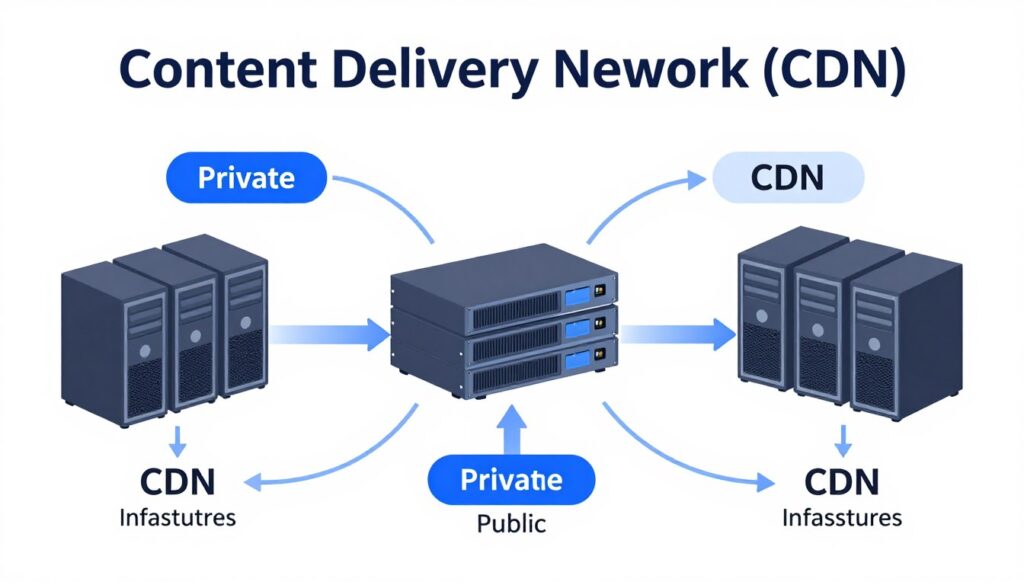
For IPTV services, hybrid CDN architectures represent a strategic combination of private and public CDN components, allowing providers to optimize for both performance and cost.
Balancing Performance and Cost
Hybrid CDN solutions utilize private CDN infrastructure for predictable traffic while leveraging public CDNs for overflow and global expansion. This approach offers several key benefits, including:
- Built-in Redundancy: Public CDN capacity automatically absorbs traffic during unexpected spikes or when private infrastructure experiences issues, ensuring continuous service availability.
- Cost-Effective Local Delivery: Regional IPTV providers can use private PoPs in core markets for local delivery while relying on public CDN partners for global reach without maintaining worldwide infrastructure.
- Flexible Scalability: Providers can gradually scale their private infrastructure based on established viewing patterns and use public CDNs to test new markets before committing to dedicated capacity.
- Tailored Content Security: Sensitive or premium content can be routed through private infrastructure, while more general content is distributed via public CDNs.
- Simplified Implementation: Modern orchestration tools have made implementing hybrid CDNs more manageable, despite the need for sophisticated traffic management and routing logic.
By adopting a hybrid CDN model, IPTV providers can enjoy the advantages of both private and public CDN solutions, creating a robust and flexible content delivery network that meets their specific service needs.
The hybrid CDN solution is particularly beneficial for IPTV providers looking to balance performance and cost. By leveraging the strengths of both private and public CDNs, providers can ensure high-quality content delivery while maintaining a scalable and reliable network of PoPs.
Key Features to Look for in CDN IPTV Services
CDN IPTV services are not created equal; understanding their key features is vital for optimal streaming. When evaluating these services, several critical aspects come into play to ensure a superior viewing experience.
Essential Capabilities for Quality Streaming
To deliver high-quality IPTV streaming, a CDN must possess certain capabilities. Peak sustained throughput capacity is crucial, as it reflects the provider’s ability to maintain quality during high-demand events. Look for CDNs that publish detailed latency benchmarks specific to your target regions, focusing on 95th-percentile values.
- Prioritize providers with demonstrated peak throughput capacity.
- Ensure they publish detailed latency benchmarks for your target regions.
- Security capabilities should include token authentication and DRM integration.
- Real-time analytics with sub-minute granularity are essential for operational visibility.
As emphasized by industry experts, “A robust CDN IPTV service must balance performance, security, and analytics to deliver a seamless viewing experience.”
Additionally, consider the CDN’s adaptive bitrate optimization capabilities and support for low-latency protocols like LL-HLS or WebRTC. Edge computing capabilities can also enhance features like server-side ad insertion and regional blackout management.
BlazingCDN: Cost-Efficient Streaming Solution

BlazingCDN offers a compelling alternative for streaming services looking for high-performance delivery at an affordable cost. As a modern, reliable CDN IPTV solution, it matches the stability and fault tolerance of major competitors like CloudFront while starting at just $4 per TB (≈$0.004/GB).
Affordable High-Performance Delivery
BlazingCDN has emerged as a compelling option for cost-conscious IPTV providers, offering enterprise-grade streaming delivery at competitive pricing. Key benefits include:
- Enterprise-grade streaming delivery starting at $4 per TB, significantly undercutting major competitors.
- 100% uptime reported during major sporting events with record-breaking traffic.
- Configurable edge rules for instant geo-blocking, automated subtitle delivery, and seamless transitions between VOD and live workflows.
- A transparent cost model that eliminates complex fee structures, potentially reducing delivery cost by up to 35%.
- Straightforward API integration with comprehensive documentation and responsive support.
For more information on building a streaming platform with CDN, visit BlazingCDN’s blog. By choosing BlazingCDN, IPTV providers can enjoy a reliable solution that ensures high performance without compromising on cdn iptv capabilities.
Cloudflare: Security-Focused CDN Provider
Cloudflare stands out as a leading CDN provider by integrating robust security features with high-performance content delivery. Its comprehensive solution is particularly beneficial for IPTV services.
Protection Against DDoS and Content Threats
Cloudflare distinguishes itself in the CDN IPTV market through its integrated security approach, combining content delivery with robust protection against DDoS attacks, bot traffic, and content scraping attempts that frequently target streaming platforms.
- The provider’s global Anycast network architecture automatically routes viewer requests to the optimal server, reducing network hops and latency while providing built-in load balancing that improves reliability during traffic spikes.
- Cloudflare’s Web Application Firewall (WAF) adds an additional security layer for IPTV platforms, protecting backend infrastructure from common vulnerabilities and attacks that could compromise content or user data.
- The platform’s edge computing capabilities allow streaming providers to deploy custom code at the network edge, enabling advanced features like personalized content, regional compliance enforcement, and server-side analytics without additional infrastructure.
- While offering comprehensive security features, Cloudflare’s analytics refresh at 30-second intervals rather than real-time, which may be insufficient for operators requiring second-by-second insight into streaming performance during critical events.
- Cloudflare’s transparent pricing model and generous free tier make it particularly attractive for emerging IPTV services looking to establish secure, reliable delivery before scaling to premium plans as their audience grows.
Amazon CloudFront: AWS-Integrated Delivery Network
Amazon CloudFront stands out as a top choice for IPTV streaming due to its tight integration with AWS services. This integration enables IPTV providers to leverage a robust content delivery network that is both efficient and scalable.
Seamless Integration with AWS Ecosystem
CloudFront offers several key benefits for IPTV providers already using AWS. These include:
- Unparalleled integration with the broader AWS ecosystem, creating a seamless workflow for IPTV providers already utilizing services like S3 for storage, MediaConvert for transcoding, or AWS Elemental for live video processing.
- A global infrastructure spanning hundreds of Points of Presence across six continents, ensuring low-latency content delivery to viewers worldwide.
- Significant operational advantages through unified billing, consistent security policies, and streamlined management through the familiar AWS console or comprehensive API.
- Powerful customization capabilities through integration with AWS Lambda@Edge, allowing providers to execute code at the network edge for content personalization and regional compliance enforcement.
- Built-in security features like field-level encryption and HTTPS support at no additional cost, with optional integration with AWS Shield for advanced DDoS protection.
- A pricing structure that includes separate charges for data transfer between regions, requiring careful planning to avoid unexpected costs.
For IPTV providers invested in the AWS ecosystem, CloudFront is a natural choice, offering a highly integrated delivery network that enhances the overall streaming service and infrastructure. To explore more about the best CDN providers for OTT and IPTV platforms, visit our detailed guide on best CDN providers for OTT and.
MwareTV: Comprehensive IPTV CDN Solutions
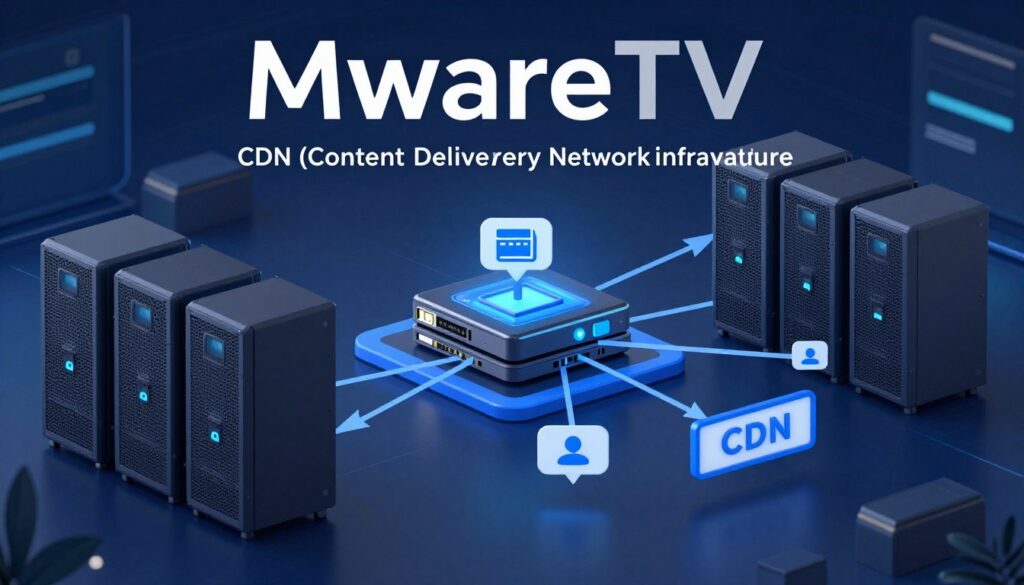
MwareTV’s comprehensive IPTV CDN solutions cater to diverse business requirements. Their platform offers three distinct CDN architectures: private, public, and hybrid, allowing service providers to choose the best fit for their audience size, geographic distribution, and budget.
End-to-End Platform for Service Providers
MwareTV’s CDN IPTV platform simplifies content ingestion by accepting multiple formats, including HLS, DASH, and MP4. Their transcoding solution optimizes streams for different devices and bandwidth conditions, automatically generating a 7-day catchup TV service.
By utilizing MwareTV’s CDN solutions, service providers can ensure secure and efficient content delivery. The optional token authentication protects streams from unauthorized access, content theft, and redistribution.
Implementing CDN for Your IPTV Platform
CDN implementation is a crucial process for IPTV platforms aiming to improve streaming performance and reliability. To achieve this, several key steps must be followed.
Best Practices for CDN Integration
Start by defining clear Key Performance Indicators (KPIs) for your IPTV platform, such as rebuffer rates and startup times. Utilize Real User Monitoring (RUM) within your player SDK to establish baseline performance metrics. Consider a multi-CDN approach using tools like Uplynk Switchboard for A/B testing. For more insights on effective CDN strategies, visit BlazingCDN’s blog.
Implement content protection measures early, including tokenized URLs and DRM integration. Gradually deploy your CDN integration, starting with non-critical traffic, and automate rollback procedures if performance degrades. Document all edge logic and configuration details for consistency and future reference.

Future Trends in CDN IPTV Technology
Emerging innovations are transforming the CDN IPTV landscape. As technology continues to advance, several key trends are shaping the future of content delivery.
Innovations Shaping the Industry
The CDN IPTV industry is witnessing significant technological advancements, including Edge AI Transcoding, which enables real-time generation of adaptive bitrate ladders, reducing storage costs and accelerating personalization.
- Ultra-low latency streaming through WebRTC is becoming mainstream, enabling sub-one-second glass-to-glass delivery for interactive experiences.
- The rollout of 5G networks is introducing new multicast capabilities, potentially reducing CDN traffic for popular live streams.
For more insights on the IPTV CDN market, you can refer to this detailed analysis.
These emerging trends are poised to revolutionize the CDN IPTV technology landscape, offering enhanced streaming experiences and improved media delivery.
Conclusion
The choice of CDN IPTV service can significantly impact your streaming performance and viewer satisfaction. To make an informed decision, consider factors such as performance needs, budget constraints, security requirements, and scalability.
Providers like BlazingCDN offer cost-effective solutions, while Cloudflare excels in security-focused implementations. For a comprehensive approach, MwareTV‘s integrated platform combines content delivery with transcoding and content management.
When selecting a CDN IPTV solution, consider a multi-CDN strategy for mission-critical streams and regularly reassess your strategy to leverage emerging technologies. For more insights on choosing a CDN provider, refer to this guide on choosing a CDN provider for video.
By evaluating these options against your unique requirements, you can confidently choose a CDN IPTV service that delivers exceptional streaming experiences while optimizing operational efficiency.