
Imagine having the freedom to watch your favorite TV shows and movies on your own schedule, without being tied to a traditional broadcast timeline. This is made possible by IPTV (Internet Protocol Television) systems, which deliver television content over IP networks rather than through conventional terrestrial, satellite, or cable formats.
Unlike traditional broadcasting methods, IPTV provides on-demand access to video content, allowing users to stream their preferred programming whenever and wherever they choose. For those interested in exploring IPTV further, you can set up IPTV on Windows to experience the flexibility it offers.
IPTV solutions have transformed how content is delivered across various sectors, including hospitality, healthcare, and educational institutions. They offer comprehensive management capabilities for live channels and video-on-demand libraries, making them ideal for both personal and commercial applications.
Key Takeaways
- IPTV systems deliver television content over IP networks, offering on-demand access to video content.
- They provide comprehensive management capabilities for live channels and video-on-demand libraries.
- IPTV solutions are ideal for both personal and commercial applications across various sectors.
- They offer flexibility and scalability in content delivery, making them a preferred choice for businesses.
- Understanding IPTV technology is essential for modernizing content distribution infrastructure.
Understanding IPTV Technology
IPTV technology is revolutionizing the way we consume television content by delivering it through Internet Protocol networks. This shift enables a more personalized and interactive viewing experience, marking a significant departure from traditional broadcasting methods.
Definition and Basic Principles
IPTV, or Internet Protocol Television, fundamentally works by delivering television content through Internet Protocol networks rather than through traditional broadcast methods like satellite or cable. The basic principle involves breaking down video content into data packets that are transmitted over IP networks and reassembled at the viewing device. This process enables a more flexible and interactive viewing experience, allowing users to request specific content from servers and creating a two-way interactive relationship between providers and viewers.
How IPTV Differs from Traditional Broadcasting
Unlike traditional broadcasting, where viewers are limited to watching what’s currently being aired, IPTV systems offer greater flexibility. IPTV allows users to access content on-demand, supporting both live television broadcasting and video-on-demand services. This flexibility is a significant advantage over traditional TV, providing viewers with more control over their viewing experience.
The Evolution of IPTV Systems
IPTV technology has evolved significantly since its inception in the mid-1990s. Initially, it offered basic streaming capabilities, but it has progressed to sophisticated systems that provide high-definition content, interactive features, and multi-device compatibility. Modern IPTV systems leverage various network infrastructures, including Coaxial, Ethernet, WiFi, and GPON (Gigabit Passive Optical Network), to deliver content efficiently across different environments. For those interested in exploring IPTV solutions, visiting a reputable provider like American IPTV Box can offer valuable insights.
| Network Infrastructure | Description | Advantages |
|---|---|---|
| Coaxial | Uses coaxial cables for data transmission | High bandwidth, reliable connection |
| Ethernet | Utilizes Ethernet cables for data transfer | Fast data transfer rates, widely supported |
| WiFi | Wireless networking technology | Convenience, mobility |
| GPON | Gigabit Passive Optical Network | High-speed data transmission, large bandwidth |
Core Components of an IPTV System
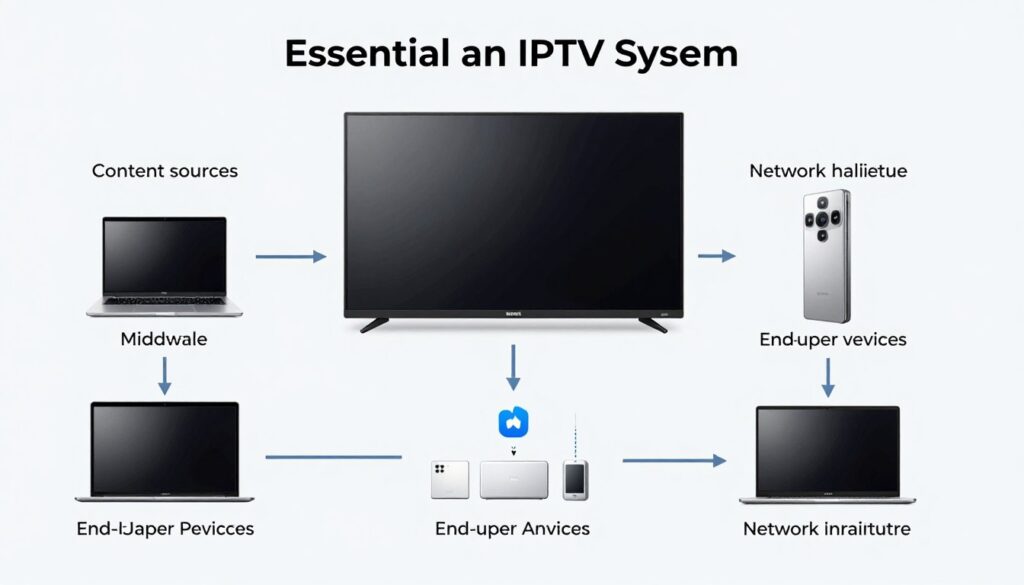
Understanding the fundamental elements of an IPTV system is crucial for its successful implementation. An IPTV system is complex and multifaceted, requiring several critical components to work together seamlessly to deliver content from sources to end-users efficiently.
Content Sources and Acquisition
Content sources and acquisition systems form the foundation of any IPTV setup, encompassing broadcast TV feeds, satellite signals, pre-recorded content libraries, and live-encoded video from cameras or other sources. The quality and diversity of content are crucial for attracting and retaining viewers.
Middleware and Management Software
The middleware layer serves as the brain of an IPTV system, providing management software like PackeTV that controls content flow, user permissions, scheduling, and the overall user experience. Management software typically offers browser-based interfaces that allow administrators to monitor system performance, manage content libraries, schedule broadcasts, and control access rights across the network.
Delivery Network Infrastructure
The delivery network infrastructure must be robust and properly configured to handle video data transmission, often utilizing multicast technology to efficiently deliver the same content to multiple viewers simultaneously. A well-designed network infrastructure is essential for minimizing latency and ensuring high-quality video delivery.
End-User Devices and Interfaces
End-user devices include set-top boxes (STBs), smart TVs, computers, tablets, and smartphones that receive and decode the IP video streams for viewing. User interfaces are crucial for accessibility, with modern IPTV systems offering customizable, intuitive interfaces that can be branded and tailored to specific applications or environments.
Key Features of Modern IPTV Systems
IPTV systems have become comprehensive content management and distribution platforms, offering a wide range of features that enhance the viewing experience. These modern systems are designed to cater to diverse needs, from live channel streaming to on-demand content and digital signage.
Live Channel Streaming Capabilities
Modern IPTV systems provide robust live channel streaming capabilities, allowing for real-time broadcasting of television channels, events, and presentations across the network. This feature supports various quality levels to accommodate different bandwidth constraints, ensuring a smooth viewing experience.
Video-on-Demand Functionality
The Video-on-Demand (VoD) functionality in IPTV systems gives users access to extensive content libraries that can be browsed and viewed at any time. This eliminates the constraints of scheduled programming and significantly enhances the user experience.

Digital Signage Integration
IPTV systems often include digital signage integration, enabling organizations to display informational content, advertisements, and announcements on screens throughout their facilities. This feature comes with scheduling capabilities and template-based design tools for ease of use.
Content Management Tools
Content management tools are a crucial component of IPTV systems, providing administrators with granular control over media assets. These tools allow for organization, tagging, scheduling, and distribution of content across different user groups or display locations.
User Interface Customization
User interface customization options enable organizations to brand the viewing experience, create intuitive navigation systems, and tailor the appearance to match their corporate identity or specific use case requirements.
| Feature | Description | Benefit |
|---|---|---|
| Live Channel Streaming | Real-time broadcasting of TV channels and events | Enhanced viewer experience |
| Video-on-Demand | Access to content libraries at any time | Increased user flexibility |
| Digital Signage | Display of informational content and advertisements | Improved information dissemination |
As IPTV systems continue to evolve, they offer a robust suite of features that transform them into complete content management and distribution platforms. By leveraging these features, organizations can significantly enhance their content delivery and management capabilities.
IPTV for Hospitality: Hotel Applications

IPTV technology is revolutionizing the hospitality sector by providing personalized entertainment and services. Hotel IPTV systems like ZAFIRO TV are at the forefront of this transformation, offering a comprehensive solution that enhances the guest experience while streamlining hotel operations.
Guest Experience Enhancement
Hotel IPTV systems deliver personalized content directly to guest rooms, allowing visitors to access information about hotel amenities, local attractions, and entertainment options through an intuitive interface. This personalized experience significantly enhances guest satisfaction.
Room-Specific Content Delivery
Room-specific content delivery enables hotels to customize the viewing experience based on room type, guest preferences, or special packages. For instance, a hotel can offer different channel lineups or promotional content to guests in different room categories, creating differentiated experiences for various customer segments.
Integration with Hotel Services
Integration with hotel services is another key benefit of IPTV systems. Guests can order room service, book spa appointments, request housekeeping, or check their bills directly through the TV interface. This not only improves convenience for guests but also reduces staff workload, allowing hotels to operate more efficiently. For more information on how IPTV compares to other streaming solutions, you can check out our analysis of Apollo Group TV competitors.
IPTV Management Systems Explained
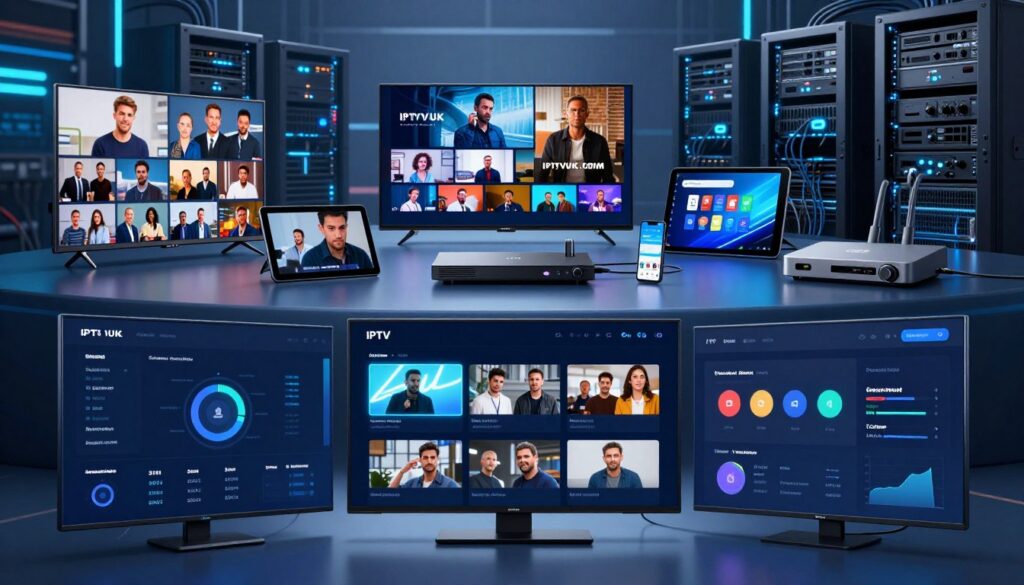
The IPTV management system serves as the central nervous system of the entire IPTV infrastructure, enabling administrators to manage content, users, and system performance efficiently. This comprehensive platform provides a range of tools and features that allow for precise control over the IPTV system.
Centralized Control Platforms
Centralized control platforms offer intuitive browser-based interfaces where administrators can manage all aspects of the system from a single dashboard. This eliminates the need to work with multiple separate tools, streamlining the management process and reducing the risk of errors.
User and Access Management
User and access management features allow administrators to create user profiles, define viewing permissions, and control content access based on roles, locations, or subscription levels. This ensures that users have access to the content they need while maintaining the security and integrity of the system.
Content Scheduling and Distribution
Content scheduling and distribution tools enable precise planning of when and where content appears, supporting both recurring schedules and special event programming across different screens or user groups. This allows administrators to optimize their content strategy and ensure that users receive the most relevant and engaging content.
Advanced IPTV management systems, such as the PackeTV management interface, provide a simple and intuitive way to manage IPTV services. The interface is labeled to direct administrators to the area of their choice, including live channels, recording, content management, playlists, virtual matrix, and set-top boxes.
Key Features of IPTV Management Systems:
- Comprehensive tools for controlling, monitoring, and optimizing content delivery
- Centralized control platforms with intuitive browser-based interfaces
- User and access management features for secure content access
- Content scheduling and distribution tools for precise planning
- Monitoring capabilities for real-time insights into system performance
- Integration with content protection mechanisms for secure content delivery
- Reporting features for detailed analytics on content popularity and system utilization
Streaming Options and Protocols in IPTV Systems
IPTV systems rely on various streaming protocols and delivery methods to transmit video content efficiently across networks. The choice of protocol and delivery method significantly impacts the system’s performance, scalability, and user experience.
Multicast vs. Unicast Delivery
IPTV systems use two primary delivery methods: multicast and unicast. Multicast delivery sends a single stream to multiple viewers, reducing bandwidth consumption and making it ideal for live TV channels with many concurrent viewers. In contrast, unicast delivery creates individual streams for each viewer, consuming more bandwidth but offering greater flexibility for on-demand content and personalized viewing experiences.
Common Streaming Protocols
Several streaming protocols are commonly used in IPTV systems. These include RTSP (Real-Time Streaming Protocol) for controlling streaming media servers, HLS (HTTP Live Streaming) for adaptive bitrate streaming across various devices, and MPEG-DASH for standardized adaptive streaming. Additional protocols like RTP (Real-time Transport Protocol) and RTMP (Real-Time Messaging Protocol) provide flexibility for different network environments and compatibility requirements.
Bandwidth Considerations
Bandwidth is a critical factor in designing IPTV systems, as video streaming, especially high-definition content, requires substantial network capacity. Proper bandwidth provisioning ensures smooth playback experiences. Advanced IPTV platforms support “pull and push” streaming methodologies and transcoding capabilities to adapt content quality based on available bandwidth and device capabilities.
| Streaming Protocol | Description | Key Features |
|---|---|---|
| RTSP | Real-Time Streaming Protocol | Controls streaming media servers, supports VOD and live streaming |
| HLS | HTTP Live Streaming | Adaptive bitrate streaming, compatible with various devices |
| MPEG-DASH | Standardized adaptive streaming | Provides high-quality streaming across different networks |

Cloud-Based vs. On-Premises IPTV Solutions

When implementing IPTV systems, organizations face a crucial decision: choosing between cloud-based, on-premises, or hybrid deployment models. Each of these models offers distinct advantages and considerations that must be evaluated based on the specific needs of the organization.
Benefits of Cloud IPTV Architecture
Cloud-based IPTV solutions leverage infrastructure providers like Amazon Web Services (AWS) to deliver exceptional scalability, allowing IPTV systems to grow seamlessly from serving a handful to thousands of users without significant capital investment. Cloud architectures typically offer superior availability (often 99.99% uptime) and reliability through redundant systems and geographic distribution, minimizing the risk of service interruptions.
Advantages of On-Premises Deployment
On-premises deployments provide organizations with complete control over their IPTV infrastructure, data, and content, which may be preferable for environments with strict security requirements or existing data center investments. Local deployments can offer lower latency and more consistent performance, particularly in environments where internet connectivity may be limited or unreliable.
Hybrid Approaches
Hybrid approaches combine elements of both cloud-based and on-premises models, such as keeping content servers on-premises while leveraging cloud services for management interfaces or content transcoding, providing a balance of control and convenience. This flexibility allows organizations to tailor their IPTV solution to their specific needs, optimizing both performance and cost.
The choice between cloud-based, on-premises, and hybrid deployment models ultimately depends on the organization’s specific requirements, including scalability needs, security considerations, and budget constraints. By understanding the advantages of each architecture and approaches, businesses can make informed decisions about their IPTV systems.
Integration Capabilities with Third-Party Systems
Advanced IPTV solutions provide comprehensive integration with various external platforms and systems, enhancing the overall user experience and operational efficiency. This integration capability is crucial for creating a seamless and unified environment for both users and administrators.
PMS Integration for Hospitality
In hospitality settings, IPTV systems can be integrated with Property Management Systems (PMS) to offer a range of benefits. This integration enables features such as automatic guest name display, room-specific messaging, billing for premium content, and express checkout directly through the TV interface. By integrating IPTV with PMS, hotels can streamline their operations and improve guest satisfaction.
Digital Rights Management (DRM)
To ensure compliance with content licensing requirements and protect premium channels and copyrighted material, IPTV systems can be integrated with Digital Rights Management (DRM) technologies. For instance, integration with Samsung LYNK and LG Pro:Idiom provides secure protection for encrypted content. This integration is vital for maintaining the integrity of the content and adhering to licensing agreements.
Room Control and Automation Systems
IPTV systems can also be integrated with room control and automation systems, allowing hotel guests to manage various in-room amenities directly through the IPTV interface. Guests can control lighting, temperature, curtains, and background music using their mobile devices or the in-room TV. This centralized control enhances the guest experience and provides a convenient way to manage their surroundings.
| Integration Type | Benefits | Examples |
|---|---|---|
| PMS Integration | Streamlined operations, improved guest satisfaction | Automatic guest name display, room-specific messaging |
| DRM Integration | Secure content protection, compliance with licensing agreements | Samsung LYNK, LG Pro:Idiom |
| Room Control Integration | Enhanced guest experience, centralized control | Control of lighting, temperature, curtains, background music |
Security Considerations for IPTV Systems
Effective IPTV security involves a combination of content protection, network security, and user authentication. As IPTV systems deliver premium content and operate in sensitive environments, security becomes paramount.
Content Protection Mechanisms
Content protection mechanisms such as encryption, watermarking, and Digital Rights Management (DRM) are crucial for safeguarding valuable media assets. For instance, integrating PackeTV with your Active Directory system can manage administration access for secure content delivery. You can find more information on best IPTV security practices on LinkedIn.
Network Security Requirements
Network security for IPTV systems includes proper segmentation, firewalls, intrusion detection systems, and regular security audits. These measures protect the IPTV infrastructure from external threats and potential breaches. For more detailed information on cyber threats to IPTV platforms, visit Infomir’s blog.

User Authentication and Access Control
User authentication and access control systems verify viewer identities and enforce viewing permissions based on subscription levels or organizational roles. Integration with enterprise authentication systems like Active Directory simplifies user management while maintaining consistent security policies.
Implementing an IPTV System: Step-by-Step Guide
Implementing an IPTV system is a multi-step process that requires careful planning and execution. A successful deployment involves several critical phases, from initial assessment to final testing.
Requirements Assessment
The first step in implementing an IPTV system is conducting a thorough requirements assessment. This involves analyzing content delivery needs, user expectations, existing infrastructure capabilities, and organizational objectives to establish clear project parameters. You need to determine the type of content to be delivered, the number of users, and the devices they will use.
Infrastructure Preparation
Infrastructure preparation is critical for ensuring that your network can support IPTV streaming. This includes assessing your current bandwidth, configuring Quality of Service (QoS), and potentially upgrading your network to support high-quality video streaming. ZAFIRO TV’s technology, for instance, can be deployed locally or in the cloud, leveraging existing hardware and cabling when possible.

System Selection and Deployment
The system selection process involves evaluating vendors based on feature sets, scalability, integration capabilities, support services, and total cost of ownership. Deployment approaches can vary, including cloud-based implementation, on-premises installation, or hybrid models that leverage existing network infrastructure such as Coax, Ethernet, WiFi, or GPON. For more detailed guidance on IPTV configuration, you can refer to this IPTV configuration guide.
Testing and Quality Assurance
Testing and quality assurance are crucial final steps. This phase involves verifying system performance under various load conditions, validating content delivery across all supported devices, and confirming that security measures effectively protect content and system access. A comprehensive testing plan ensures a smooth user experience and reliable system operation.
| Implementation Phase | Key Activities | Importance Level |
|---|---|---|
| Requirements Assessment | Analyze content needs, user expectations, infrastructure capabilities | High |
| Infrastructure Preparation | Assess bandwidth, configure QoS, upgrade network if necessary | High |
| System Selection and Deployment | Evaluate vendors, choose deployment model (cloud, on-premises, hybrid) | High |
| Testing and Quality Assurance | Verify system performance, validate content delivery, ensure security | High |
IPTV System Costs and ROI Considerations

IPTV system costs can be complex, involving various factors that impact the overall return on investment (ROI). To make informed decisions, businesses must understand both the initial investment and ongoing operational expenses associated with IPTV systems.
Initial Investment Factors
The initial investment for an IPTV system includes several key factors: hardware costs such as servers, encoders, and set-top boxes; software licensing fees; network infrastructure upgrades; content acquisition; and professional services for design and implementation. The scale of deployment significantly impacts these costs, with per-user expenses typically decreasing as the system grows, making IPTV particularly cost-effective for larger organizations or properties.
Ongoing Operational Expenses
Ongoing operational expenses for IPTV systems encompass software maintenance agreements, content licensing fees, network bandwidth costs, hardware replacement reserves, and technical support resources. Cloud-based solutions typically shift costs from capital expenditures to operational expenses, with subscription-based pricing models that scale with usage and eliminate large upfront investments.
Return on Investment Analysis
Return on investment analysis for IPTV systems should consider both tangible benefits, such as reduced cable TV subscriptions and new revenue opportunities, and intangible benefits, like improved user experience and enhanced brand perception. For hospitality applications, ROI calculations should include potential revenue from premium content and increased guest satisfaction scores. In corporate environments, IPTV may realize ROI through improved internal communications and more effective training delivery.
Conclusion: The Future of IPTV Systems
The IPTV landscape is rapidly evolving, driven by technological advancements and changing consumer behaviors. As IPTV systems continue to mature, we can expect significant enhancements in content delivery and user experience. Artificial intelligence and machine learning are being integrated into IPTV platforms to provide personalized content recommendations and improve system efficiency.
The convergence of traditional television, streaming services, and interactive applications is creating comprehensive entertainment ecosystems. With the expansion of 5G networks, mobile IPTV experiences will become more robust, reducing the reliance on fixed infrastructure. Additionally, voice control and gesture recognition are making IPTV systems more accessible and intuitive.
As IPTV technology advances, we can anticipate greater standardization and improved interoperability between different vendors’ solutions. Organizations that strategically implement and continuously optimize their IPTV systems will be well-positioned to deliver compelling content experiences. For more insights on the future of IPTV, visit Vodlix’s blog on the future of.